Hill Country/Texas Wine Country/Fredericksburg/Settlers Crossing
Historic houses · Fredericksburg
Settlers Crossing
Eight houses that crossed different distances and different centuries to meet on one Texas property. Some were built in the Hill Country. Others came from Indiana, Missouri, Pennsylvania and western Kentucky. What makes them worth the walk is not only their age. It is what they show about how people built, heated, cooled, defended and moved their homes.
Ask about Settlers Crossing
Which house is oldest, how they got here, what a dog-trot is. Cooper knows the history of every building on the property.
Ask about any house on the property, the families behind them, or the animals.
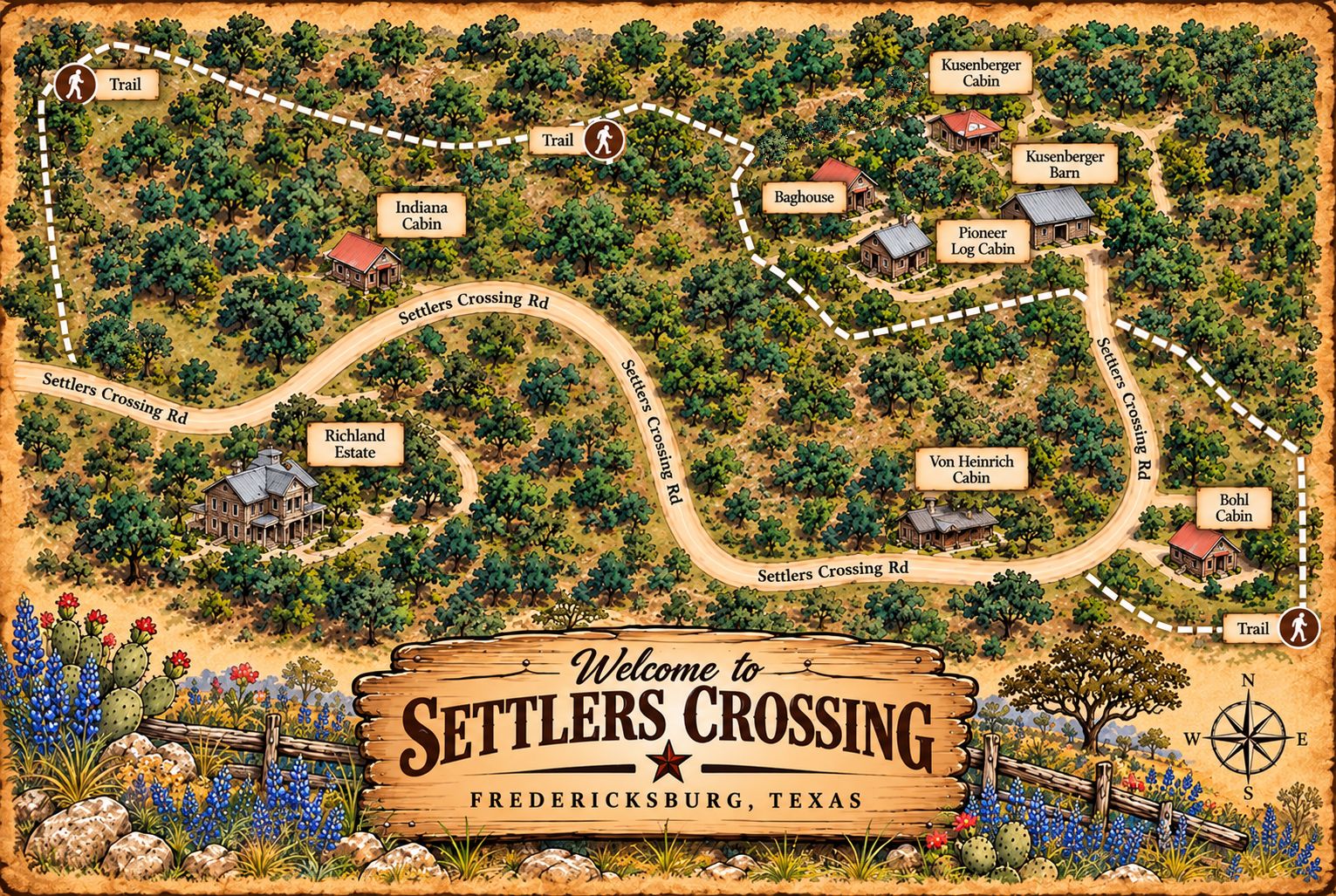
Walk the trail
Start at the bridge by the front entrance and take the trail all the way around. The houses are listed in the order you will reach them.
- Stop 1 · On your left, the first house on the trailEarly 1900s
Baag Farm House
A wedding gift for a descendant of one of the area’s original settler families. Tall ceilings, a porch, blue with white trim: a family settled enough to build for comfort, not just survival.
See the house → - Stop 2 · The next house on your leftAround 1865 · Texas
Pioneer Log Cabin
A log-and-rock cottage that sheltered four generations of one Texas family. It was built as a dog-trot: two rooms either side of an open breezeway that caught the wind. Below it is a cellar for cool storage.
See the house → - Stop 3 · Cross the cattle guard; on your leftAround 1865 · Hill Country
Kusenberger Barn
Two stories of native limestone, walls about two feet thick, and narrow gun slots. Built as the Civil War ended, when protecting people, animals and supplies was part of farm design.
See the house → - Stop 4 · At the end of the road1847 · Hill Country
Kusenberger Log Cabin
One room of hand-hewn logs and stone, with its original stone floor, a big stone fireplace and low doorways that kept the heat in and were easier to defend. Built in 1847, a year after Fredericksburg was founded. Family history says it began with the Weiershausen family, who were later joined to the Kusenbergers by marriage.
See the house → - Stop 5 · Back at the cattle guard, take a left and follow the trail around1850 · Missouri
Bohl Cabin
A two-story hand-hewn log cabin, taken apart, moved south and rebuilt log by log. The best place to see what hand-hewn means: every wall log was shaped by someone with an axe.
See the house → - Stop 6 · Directly in front of you1787 · Pennsylvania
Von Heinrich Home
Fachwerk: a heavy timber frame with diagonal bracing and limestone infill, in a Pennsylvania German building tradition that began in central Europe. Built in the early years of the United States and moved to the Hill Country generations later.
See the house → - Stop 7 · Follow the main road back toward the bridge; on your right1849 · Indiana
Indiana House
A farmhouse taken down, hauled about 1,200 miles south and rebuilt piece by piece under the oaks here, with its original framing.
See the house → - Stop 8 · On your left1790s · Ohio River, western Kentucky
Richland Estate
Thirteen rooms, six fireplaces, wide-board floors and hand-hewn beams. Six hearths were the heating and cooking system of a large household. Moved to Settlers Crossing for restoration in 1989, the one move date on record.
See the house →
The animals
Paco is Settlers Crossing’s resident donkey. Sheep graze the property, and deer still move through the oaks and pastures. They are part of the place’s living history: one more way it stays a working landscape rather than a collection of buildings behind glass.
What we are still finding out
Only Richland Estate’s 1989 move is on record. The year each of the other houses arrived, the towns they came from and the original owners are still being researched, along with the Kusenberger and Weiershausen deed history. Where a story comes from family tradition, we say so.
Found something worth a second look?
Share a photograph, a family connection or a detail we may have missed in the Texas Hill Country Community on Facebook. The houses have already traveled a long way. Their stories can keep traveling.
“Share this page” opens Facebook with this page attached, and you choose where it goes, including the group. “Post in the group” opens the group so you can add your own photos.
Sources
- City of Fredericksburg, History
- Texas State Historical Association, Handbook of Texas: Fredericksburg, Battle of the Nueces, Germans
- Pennsylvania Historical and Museum Commission, Pennsylvania German architecture
- National Park Service, The Ohio River Valley
- Settlers Crossing property materials and the property sale record
Construction years follow the published property materials and sale record. Checked 17 October 2026.