Story · Sisterdale
Jess and I spent part of yesterday looking for a historical marker in Sisterdale. I had the GPS coordinates. We drove directly to them, stopped, and couldn’t find it. No pullout. No path. Nothing pointing toward it. Just a fence line, tall grass, and some scattered trash.
We were parked directly in front of the thing. It still took us a minute.
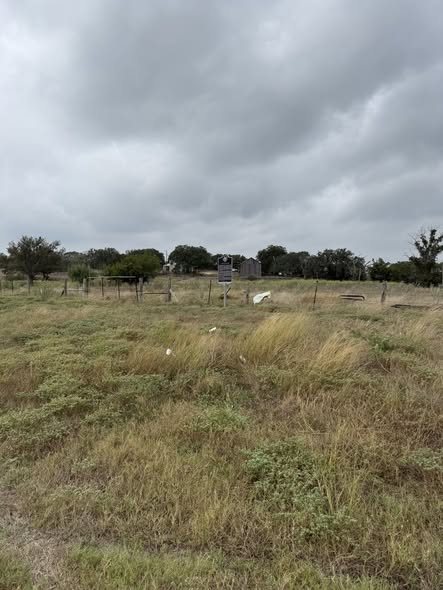
The marker is for a German baron named Ottomar von Behr, who settled in this valley in the late 1840s. I’d never heard of him.
That turned into a problem. Because once I started reading about von Behr, Sisterdale stopped making any sense at all.
In early 1854, a thirty-one-year-old writer from New York rode through this country trying to explain Texas to people back East. Four years later, he and Calvert Vaux would win the competition to design Central Park. His name was Frederick Law Olmsted.
He had some trouble with Sisterdale. He wrote:
“You are welcomed by a figure in blue flannel shirt and pendant beard, quoting Tacitus, having in one hand a long pipe, in the other a butcher’s knife; Madonnas upon log walls; coffee in tin cups upon fine Dresden saucers; barrels for seats, to hear a Beethoven’s symphony on the grand piano; a book-case half filled with classics, half with sweet potatoes.”
A bookcase half classics, half sweet potatoes.
That wasn’t one house. Olmsted was trying to describe educated German settlers generally. Sisterdale was one of the most vivid local examples he found.
Maybe that’s why he stayed four nights.
This wasn’t really a town. It was a series of large farms along a creek, populated by German immigrants, many of them unusually well educated. The state historical marker describes Sisterdale as a Latin Colony: its well-educated citizens often read and debated in Latin.
Farmers. Arguing in Latin.
Many had come out of the failed German revolutions of 1848. They had left professional standing and political frustration behind and brought books, languages, and arguments to an unplatted farming settlement.
Olmsted arrived and soon met a German baron and another herdsman riding mustangs through the rocks looking for cattle. The baron invited him home to his “castle.” It was a log house he had built himself. Most of it was still a barn. The family lived in the other part, separated from the animals by deerskins and calico.
His wife fed Olmsted jerked beef, cornbread, and hot bouillon in tin goblets. Then she proudly showed him their baby, which she said weighed nearly twice what a German baby normally weighed at the same age.
The house was half barn. The baby was magnificent.
Then Olmsted went to von Behr’s place. The man whose marker we couldn’t find.
Von Behr’s father was a high official in the Duchy of Anhalt-Cöthen. Von Behr himself was a friend of Alexander von Humboldt—the naturalist, one of the most famous scientists in the world at the time, and the namesake of a Pacific current, a penguin, and three U.S. counties. He came to Texas to farm and raise sheep. His home had books, pictures, and a harpsichord. He also maintained a lending library that the Handbook of Texas calls possibly the first in Texas.
There was barely a town. There was a library.
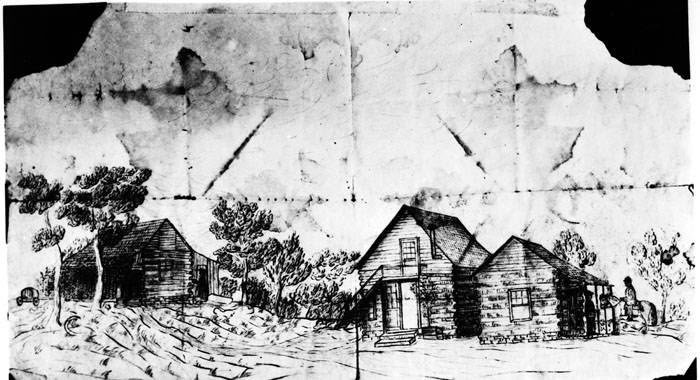
For some perspective: Galveston’s subscription Mercantile Library opened in 1871 and was described as Texas’s first public standard and circulating library. Von Behr was lending books from a log-and-fachwerk house in the 1850s.
Von Behr was also the justice of the peace. While Olmsted was there, visitors arrived with a legal dispute. Von Behr turned his dining room into a courtroom, heard the case, and reconciled the parties by fixing the value of a dog somebody had shot.
So before he and Calvert Vaux won the Central Park competition, Olmsted spent part of a day in Kendall County watching a German nobleman adjudicate the value of a dead dog.
And somehow that wasn’t the strangest thing going on in Sisterdale.
A neighbor named Ernst Kapp had opened a spa. An actual spa. In Sisterdale. In the 1850s.
He called it Badenthal—roughly, Bath Valley. A lithograph from the period advertised “Dr. Ernest Kapp’s Water-Cure,” with baths, wet-sheet treatments, a spring, and even a “place for gymnastic exercises.” This was happening while people were still traveling through the Hill Country in wagons.
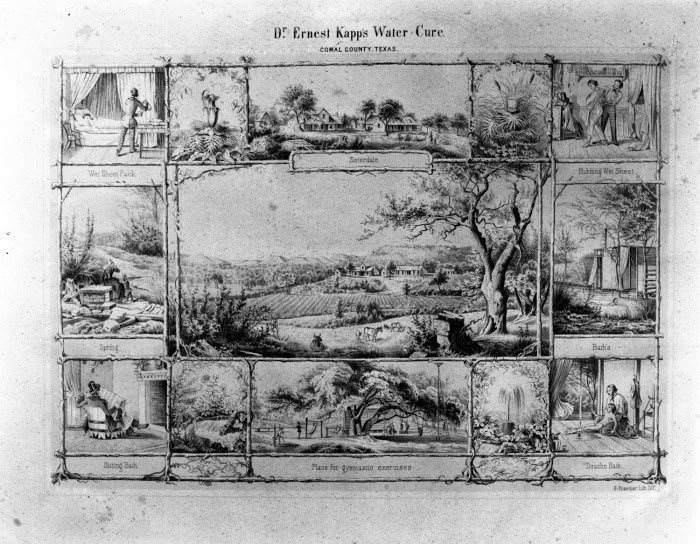
Kapp went back to Germany in 1865 and, twelve years later, wrote a book arguing that technologies model, project, or extend the human body. An axe extends the arm. A lens extends the eye. It is widely considered a foundational work in the philosophy of technology.
And the question has not gone away. The AI industry is still trying to work out where the human ends and the tool begins.
Kapp didn’t write it at the bathhouse. But his years in Texas—farming, carpentry, stock raising, and running the water cure—were part of the experience behind it.
Another evening Olmsted ended up in Eduard Degener’s log cabin, where a fine piano was playing. The company performed concerted pieces from Mozart’s Don Giovanni, danced, and, after the women went to bed, the men sang German student songs.
Elsewhere he found a three-hundred-dollar fowling-piece—basically a fancy shotgun—sitting on a five-dollar saddle. One settler told him, “My wife made these pantaloons and my stockings grew in the field yonder.” He met German teamsters camped on the prairie, their cattle staked around them, lying on the ground and looking up into the endless night sky while humming airs from Mozart’s Don Giovanni and reciting Dante and Schiller.
And some of these men were living in holes in the rocks along the Guadalupe.
So picture it. You’re walking the river. You come across a man living in a hole in the rock, splitting shingles for a living. You stop to buy roofing material, and the next thing you know you’re in a conversation about metaphysics.
That is roughly the world Olmsted was trying to describe.
Describing von Behr’s house, he called it:
“the very picture of good-nature, science, and back-woods.”
That’s still about as good a description of Sisterdale as anybody has come up with.
And here’s the part I like. Some of it is still there.
Olmsted wrote that he had “rarely seen any resort of wood-nymphs more perfect than the bower of cypress branches and vines that overhang the mouth of Sister Creek.” The mouth of Sister Creek is where it meets the Guadalupe. I took the photo from almost the exact spot he described in 1854.
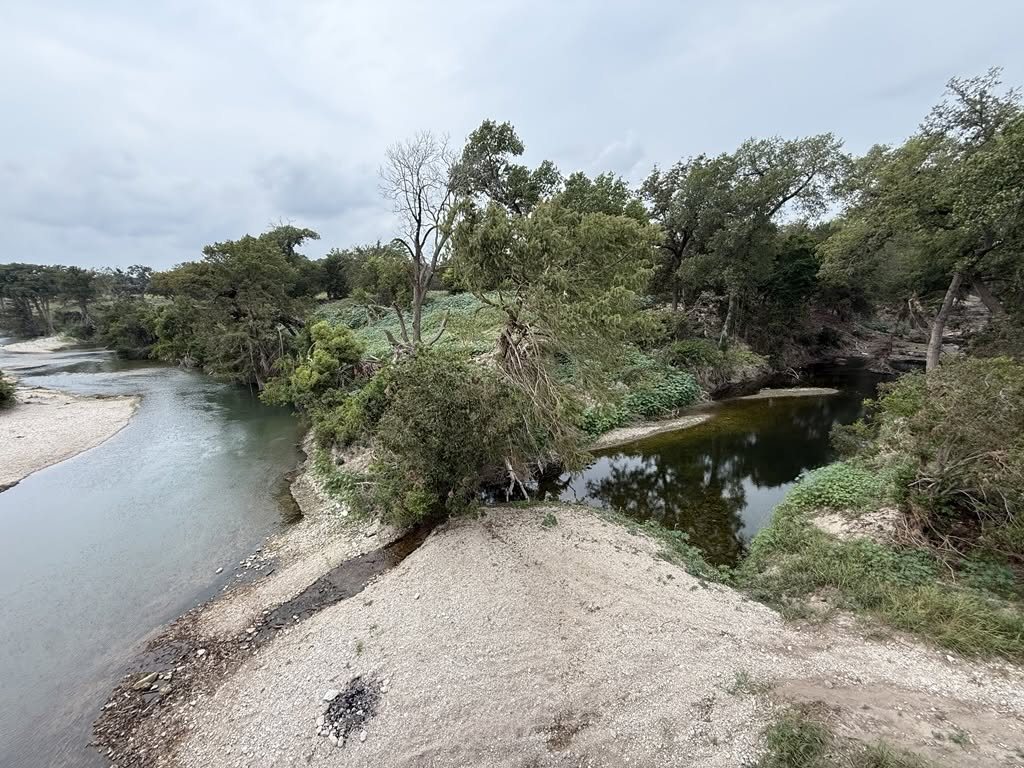
It looks different now. Two recent floods have traded some of Olmsted’s green curtain for gravel bars, exposed roots, and a clearer view of the water. The wood-nymphs may have moved upstream for the season.
Kapp’s log home and adjacent patient quarters survive on private property. And a current real-estate listing describes the 310-acre Sisterdale Farms tract as land once owned by Ottomar von Behr.
Sisterdale Farms is advertised at $19.4 million. The big stone house in the photographs is the newer 11,800-square-foot main residence. But down toward the river stands a separate historic German homestead that the listing says was built in 1870 by von Behr’s oldest son. It has been restored and is included in the same estate.
So von Behr’s old world did not disappear. It became a 310-acre estate with two libraries, a pizza oven, and a mortgage calculator that produces numbers no nineteenth-century German farmer would have believed.
And it wasn’t just those two men. One of the figures associated with Sisterdale was Karl Marx’s brother-in-law, Edgar von Westphalen, an old friend from their student days.
While Marx was in London writing ideas that would rearrange half the planet, his brother-in-law was out here in Kendall County, in a place where somebody still had to mend the fences before the cattle got out.
The newspaper editor who rode in with Olmsted that first day went north a few years later and opened an early German kindergarten in Boston. And another man associated with the settlement was Julius Fröbel, nephew of Friedrich Fröbel, the German educator who founded the kindergarten system.
Eight or ten farms on a creek in Kendall County.
The historical marker for von Behr is still there too.
Technically.
Jess and I finally found it. So I tied a piece of red reflective tape around the post. If you go looking for it, the coordinates are 29.9546388, -98.71801713. It is on Highway 1376, south of the Guadalupe. Use a safe, legal place to stop, then slow down and look for the red tape.
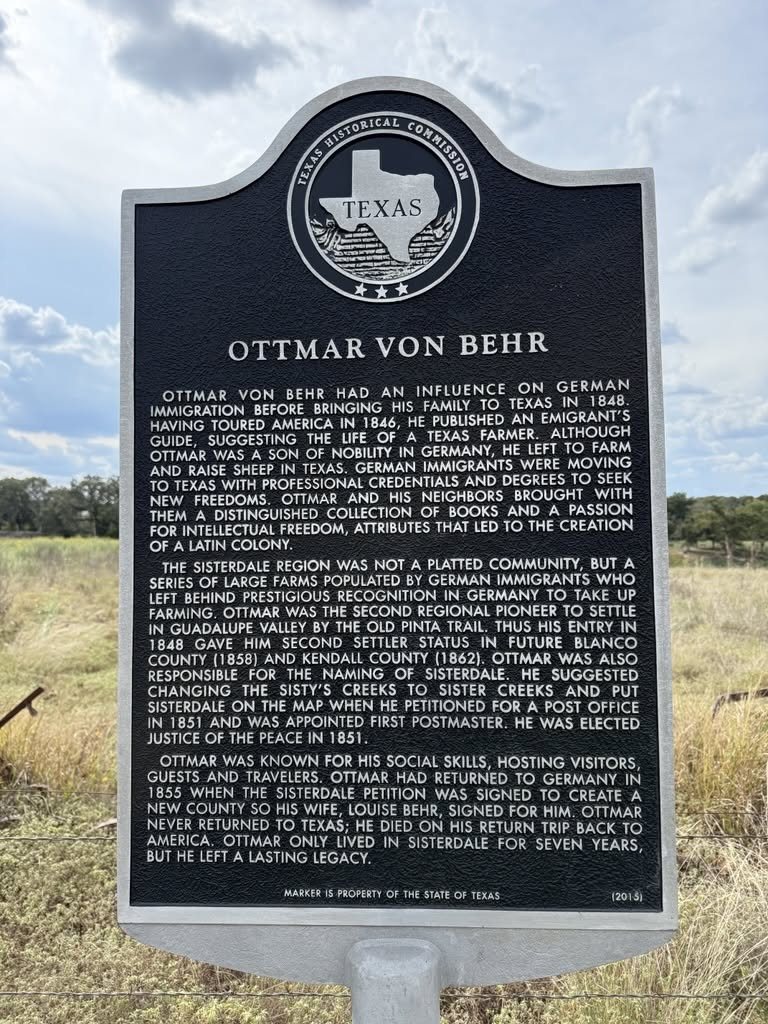
That’s him.
I’m going back with a weed eater, if I can get permission. Not out of any great civic feeling. It just bothers me.
A German aristocrat came to a nearly empty piece of Texas, raised sheep, kept what may have been one of the state’s earliest lending libraries, held court in his dining room, and—according to the historical marker—suggested changing the local creeks’ name from Sisty’s to Sisters, which is how Sisterdale got its name.
He made a place for books in a country that barely had a town. Frederick Law Olmsted came through and wrote about the whole strange little world.
And now you can’t read the man’s marker from thirty feet away.
Twenty minutes with a weed eater—and the right permission—fixes it. That’s the entire preservation plan.
Maybe that’s the thing about history.
Sometimes it doesn’t disappear.
Sometimes it’s sitting right in front of you, in the weeds, and you drive past at fifty-five.
Go see it. The marker is on the west side of FM 1376, about 0.3 mile south of the Guadalupe River. Ottmar von Behr Historical Marker · Sisterdale · The FM 1376 drive
Image credits
- Ottomar von Behr’s home, library and post office, Sisterdale, Texas, about 1855. General Photograph Collection, 076-0149, UTSA Special Collections.
- Badenthal / Dr. Ernest Kapp’s Water-Cure, Comal County, Texas, about the 1850s. The Portal to Texas History, University of North Texas Libraries, crediting the Texas Historical Commission, texashistory.unt.edu.
- Marker and Sister Creek photographs by Spencer Forrest, November 2026.