Story · Boerne and Pipe Creek
There is a gate on Highway 46 between Boerne and Pipe Creek that has been closed for fifteen years. Most of us have driven past it a few hundred times without wondering.
Behind it are 3,852 acres that have never been ranched. The Albert and Bessie Kronkosky State Natural Area. Not lightly ranched, not a long time ago — never. The superintendent, James Rice, said it plainly in Texas Parks and Wildlife Magazine: “This place was never ranched, so those impacts are not present. That leaves us with a slice of the Texas Hill Country that is rare and rapidly disappearing.”
Sit with that a second. Across most of this country, generations of grazing changed the grass, the browse, and the way water moves across the ground. Cattle, then sheep, then goats, working some places for more than a century without a break. Add fire suppression and clearing on top of it and the landscape changed so thoroughly that we mistake what came after for what was always here.
That gate has a piece of Hill Country behind it that skipped the biggest chapter of that.
And then there is the deer mystery. Rice says there was a herd on the property up until about 1995 or 1996, and then the population crashed. Nobody has explained why. What it left behind is a place where seedling Texas madrone, red oak, and big-tooth maple are coming up by the hundreds — young trees that across most of the Hill Country get browsed off before they ever clear knee height. Rice looks at that and worries out loud about everywhere else. “What are we going to be left with in about 50, 60, 70 years?”
Albert Kronkosky Jr. was born in Boerne in 1908. His people had come to New Braunfels in 1850 and moved to San Antonio in 1885, where his father, Albert Sr., built a fortune on two things — the Gebhardt chili powder company, founded in 1896 by a German immigrant brother-in-law who had figured out how to dry and grind ancho peppers behind his New Braunfels café so people could have chili year round, and a friendship with George Merck.
Family history says Merck fell ill while visiting San Antonio, Albert Sr. looked after him, and Merck thanked him with company stock. Published accounts repeat it. Whether or not that is how it started, it is not how it grew — he kept buying for decades, with chili powder and drugstore money, and by the time George Merck died in 1957 Albert Kronkosky Sr. was the company’s single largest individual shareholder.
Chili powder made the family successful. Merck stock made them extraordinarily wealthy.
In 1946 they started buying the land behind that gate — a few miles west of Boerne, near where he was born — and kept at it until 1973. Bessie was forty when they started. They hunted it, photographed the wildlife on it, brought friends out. One of the streams is called Bessie’s Creek. They called the place a ranch and never ran a cow on it.
They had no children.
So they gave both inheritances away. The money went into a charitable foundation — Albert’s estate alone put $295 million into it in 1997 — that has funded work across Bandera, Bexar, Comal and Kendall counties ever since. And the land was willed to the State of Texas so it would be protected from development.
Albert died in 1995.
Bessie died on the first of September, 2010, at a hundred and three. The state accepted the land six months later. She never saw the paperwork finish.
Which means she spent the last fifteen years of her life holding land she had already decided to give away, in a stretch of country where every neighboring tract was worth more cut up than whole. She did not sell a piece of it.
Neither of them lived to see a single member of the public walk a trail on ground they had handed over.
What is out there is what they were protecting. Oak-juniper woodlands and clear-running streams. Foxes and ring-tailed cats. Big-tooth maples, which people associate with Lost Maples and do not expect this far south. Golden-cheeked warblers, which breed in central Texas and nowhere else on earth — not Mexico, not the coast, not east Texas. Here. Texas alligator lizards, the Texas spring salamander, the sycamore-leaf snowbell, and the Boerne bean, which grows in a handful of counties and nowhere else.
Springs and weeps all through it. Rice calls the site fragile every time somebody puts a microphone in front of him, and he is blunt about the order of priorities: “A state natural area, the number one purpose is resource conservation. The resource comes first.”
When it opens there will be hiking, backpacking, camping, a nature center, an environmental classroom, and limited mountain biking. But the thing Rice keeps returning to is access — he says ABK is meant to be a model for the whole state park system, and that people with mobility, sight, or hearing limitations should get the full experience, not just at the buildings but out on the trail. That is not a small ambition on ground this rough.
It is a State Natural Area, not a state park. State parks are designed around visitors. Natural areas are designed around what is already living there. That is why daily visitation will be capped and reservations required, the way Enchanted Rock and Lost Maples do it.
Some of us will get turned away the first year. That is the right call. The only reason there is anything worth driving out to see is that two people decided it should stay as it was.
Texas Parks and Wildlife was targeting fall of this year when I wrote this. As of November 2026, the state’s page says it has not set an opening date.
I stopped by. That is the new sign and the road running in. That is as far as anybody gets right now.
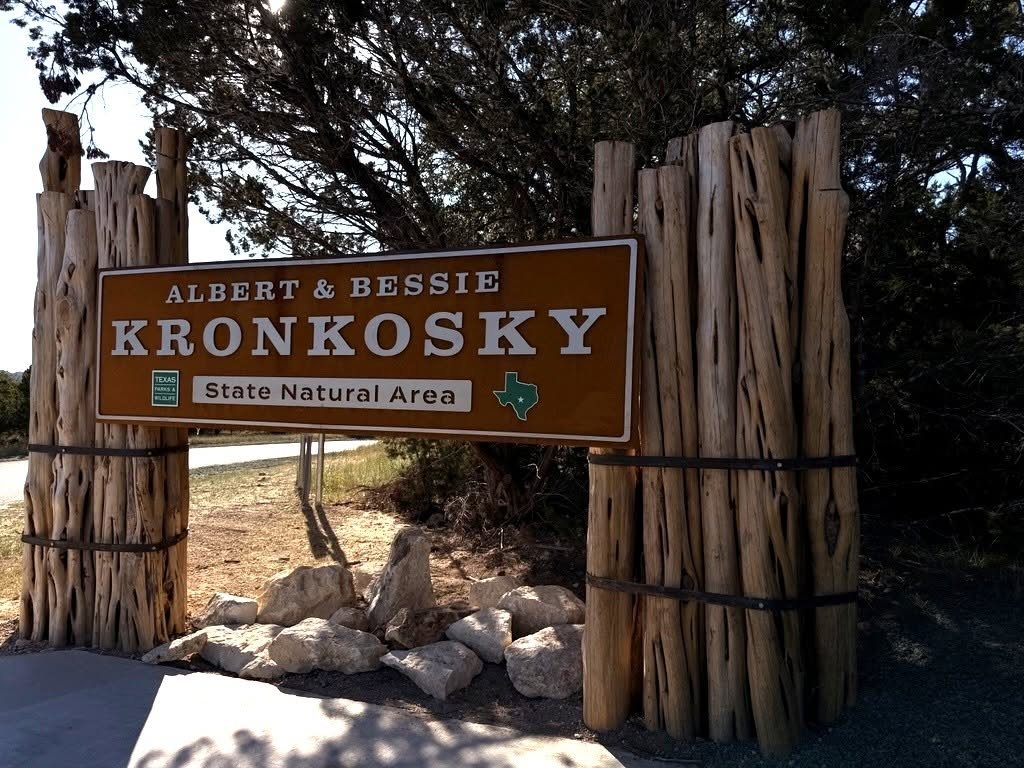
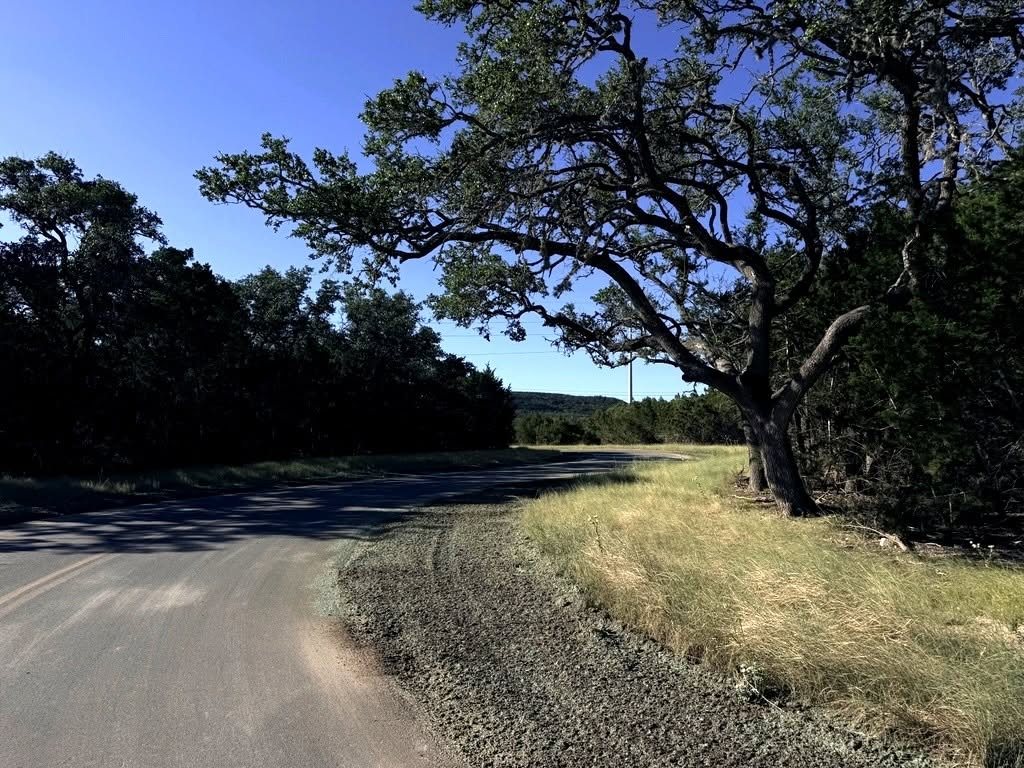
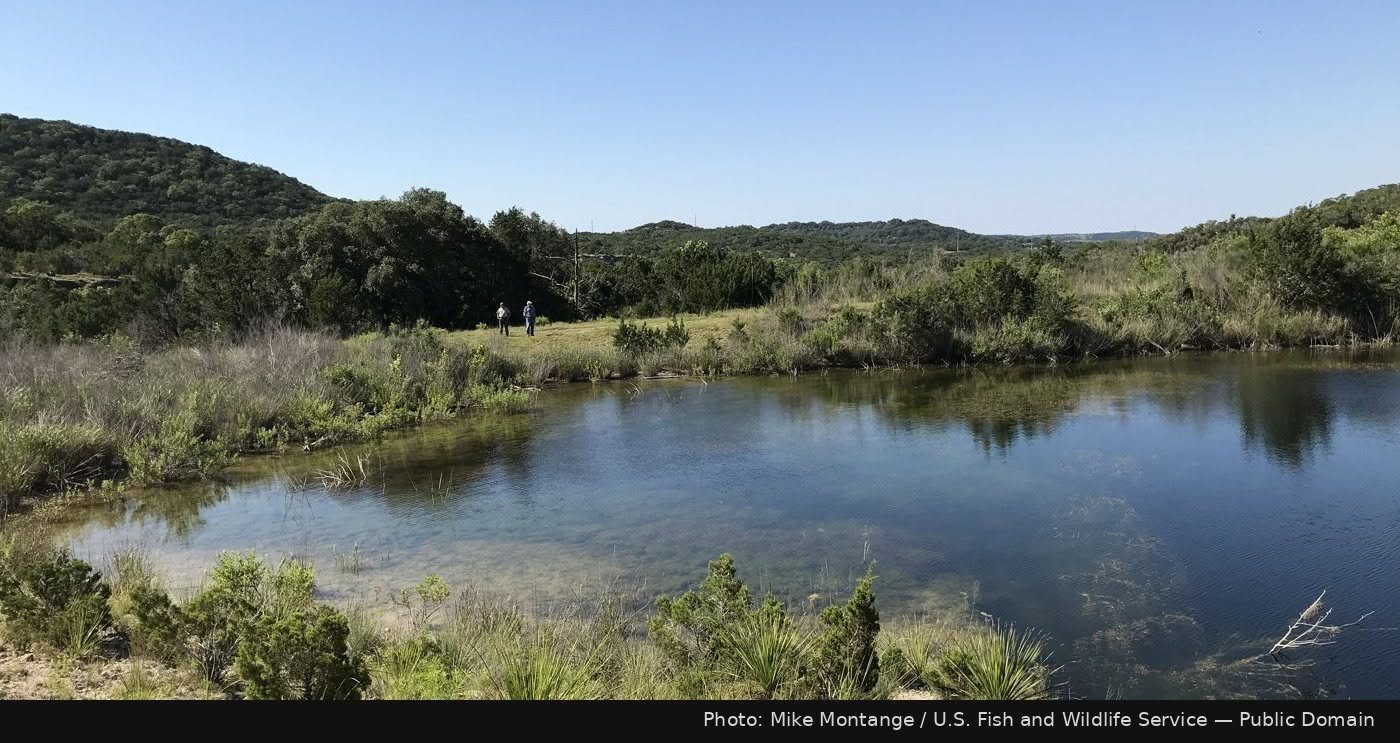
The picture of the pool is from inside, taken by Fish and Wildlife in 2023. That pool is an old impoundment, and the dam holding it back is coming out so the creek can run the way it used to.
There is not much country left around here that was never put under livestock, and there is not going to be any more of it. What is behind that gate is about as close as we can get to a photograph of what this place looked like before we changed it.
Go see it. It sits in both Bandera and Kendall counties, on Highway 46 between Boerne and Pipe Creek. Not open yet. Albert and Bessie Kronkosky State Natural Area · Texas Parks and Wildlife updates