Hill Country/Southern Hill Country/D'Hanis
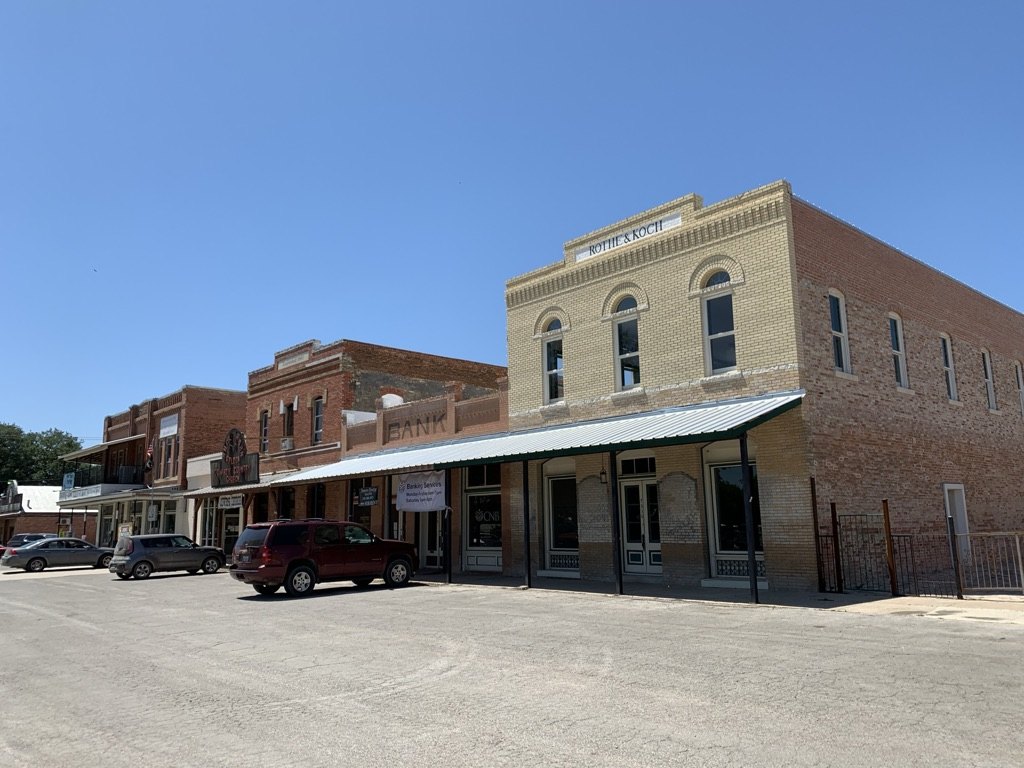

D'Hanis is an unincorporated U.S. 90 community in Medina County whose identity is split between an 1847 colony east of the highway town, the railroad settlement that replaced it, and a brick industry that linked local clay to buildings across Texas.
Ask Émilie
Your guide to D'Hanis and the rest of Southern Hill Country.
The steep-pitched houses, St. Louis Church, the brickworks at D’Hanis, and the flood gauge at the old mill.
The name now refers chiefly to the inhabited place around U.S. 90, FM 1796, FM 2200, and the rail line west of Hondo. Residents and historical sources use **Old D'Hanis** for the first colony, about a mile and a half east of the present center, while the railroad community was once called **New D'Hanis** before “new” disappeared from ordinary use. That distinction is not a minor naming detail. It explains why the church ruin and old cemetery lie apart from the current parish, school, businesses, and community facilities.
D'Hanis is also not an open-air museum. The old district includes private rural property; the best-known brick plant is an active industrial site; several markers stand where no designated visitor parking could be confirmed; and the historic hotel is no longer supported by a current lodging source. The public-facing places with clear terms are fewer: an active parish during scheduled worship and events, a reservable community center, and a developing recreation park.
The 1847 Colony and Old D'Hanis
Henri Castro's colonization effort established D'Hanis in 1847 through Theodore Gentilz and twenty-nine Alsatian families. The settlers received town lots and farm tracts on what was then a frontier route. Early shelter relied on available materials before more durable stone houses appeared, and Catholic worship began within the new community.
Fort Lincoln opened north of the settlement in 1849. Its brief military presence supplied employment and protection during the colony's vulnerable first years, although the post itself did not become the permanent center of D'Hanis. Saint Dominic Catholic Church followed in the 1850s and was enlarged as the congregation developed. The cemetery, church arches, and two historical markers now provide the clearest surviving reference points for the original townsite.
The district's National Register listing records the historical significance of this rural landscape, but designation is not an access permit. Current research did not establish designated visitor parking or explicit owner or parish terms for entering the cemetery or ruins. The Saint Dominic and Old D'Hanis record therefore remains an access hold rather than a published invitation. The history belongs in the town narrative even when the physical approach cannot yet be recommended.
How the Railroad Created the Present Town
The Galveston, Harrisburg and San Antonio Railway crossed Medina County in 1881 but passed west of the first settlement. A depot area developed beside the tracks, and residents, businesses, and the post office shifted toward it over the following years. The change produced the two-place vocabulary that still matters today: the colony became Old D'Hanis, while New D'Hanis became the community now shown on highway maps.
The railroad did more than move the center of settlement. It connected local cattle, cotton, and manufactured building materials to larger markets. Hotels and stores clustered near the new transportation corridor, and the community added schools, churches, newspapers, mills, and banking services as it matured. The depot itself is not a verified surviving attraction, and the tracks remain active transportation infrastructure rather than public space. Their role is historical and geographic: they explain why the present town occupies a different site from the place founded in 1847.
Brick Country
Brick is the material that ties the railroad town to the surrounding land. Historical sources do not describe the early business chronology in exactly the same way. The Handbook of Texas places a D'Hanis brick-and-tile company in the 1880s, while a Medina County historical marker records the organization of the later company in 1905 after local clay was tested for commercial production. Taken together, the records show a developing local industry rather than a single undifferentiated founding moment.
The county marker associates production with an iron-bearing clay deposit near Seco Creek and describes kilns, presses, engines, and rail movement as the operation expanded. A current regional distributor still lists D'Hanis Brick & Tile among its manufacturers, supporting the conclusion that the name remains part of the commercial brick market. That evidence does not establish factory tourism. The company website identified in older listings no longer resolves, and no present tour, visitor center, or general plant admission was found. The marker is also beside a narrow approach at the working entrance, without independent visitor parking. The plant should be understood as an active industry, not entered as a sightseeing stop.
Brick also survives in the visual character of present-day D'Hanis. The 1906 J. M. Koch building, Holy Cross parish complex, and other commercial and residential structures show how local material entered the townscape. No official brick-architecture route was verified, however, so private buildings should not be assembled into an implied walking tour.
Parish and Community Continuity
Holy Cross Catholic Church represents continuity between the two D'Hanis sites. The congregation's roots precede the railroad move, while the present parish serves the later town. The church publishes current Mass, confession, office, and event information, which establishes access for those scheduled purposes. It does not establish unrestricted touring of the sanctuary, school building, grotto, cemetery, or other parish grounds.
The same distinction applies to civic places. The D'Hanis Lions Club publishes rental terms and contact information for its community center, making it useful for a confirmed booking or announced public event rather than a casual drop-in. Finger Memorial Park provides the broadest ordinary public access. Its first-party site identifies a walking trail, playground, sand-volleyball area, pickleball and basketball court, and a developing youth ball field; it also states that the gates open daily from daylight to dark and that the trail remains accessible at all hours.
Practical Information
Begin with the difference between **historical importance** and **permission to visit**. Finger Memorial Park has explicit public hours and a designated approach. Holy Cross Catholic Church is appropriate during its posted worship, office, or announced-event schedule. The Lions Club Community Center requires a confirmed rental or a listed public event.
Do not enter the D'Hanis Brick and Tile Company, use its driveway to reach the marker, or treat the industrial grounds as a public tour. Do not enter active railroad property. The Saint Dominic ruins and Old D'Hanis Cemetery remain held until parking and property access are confirmed. Other roadside markers should not be approached by stopping in a travel lane or using an ordinary shoulder, gate apron, or private yard.
Why It Matters
D'Hanis makes sense only when its two centers are read together. The eastern site records a colonization-era community organized before the railroad; the western site records the decision people made when transportation and trade shifted. The brickworks then added a durable local industry whose products and influence outlasted the earliest settlement pattern.
That layered story is more useful than presenting D'Hanis as a generalized old town. Its surviving evidence is uneven: some places remain active, some are ruins, some are private, and some have disappeared. A responsible visitor guide should preserve all four conditions. The result is a smaller POI list, but a clearer account of how an immigrant colony, a railroad, a parish, and a manufacturing tradition produced the place now called D'Hanis.
Things to do
3 places in and around D'Hanis.
Nothing in that category here yet.
Stays in D Hanis
1 Backroads-managed house in D Hanis.
1 house here, 4 more within the region
Nearby
The rest of Émilie’s territory.